
What a Website Can Do for Your Business When You Stop Treating It Like a Brochure
She was telling me about Egypt.
The waters. The baths. The luxury rooms. The boat ride along the Nile. The ceremonies held in temples that have witnessed thousands of years of prayer and remembrance. The feeling of arriving somewhere ancient and sacred and realizing you have been there before, in some deep place inside yourself that you forgot you had.
I was listening. And I was looking at her website at the same time.
A twirling font that felt random. Colors that seemed accidental, not chosen. Nothing on that screen that matched what was pouring out of her voice. If you had landed on that site without ever meeting Paola, you would have had no idea what was waiting for you on the other side of that booking button.
That is the moment I understood what a website is really supposed to do.
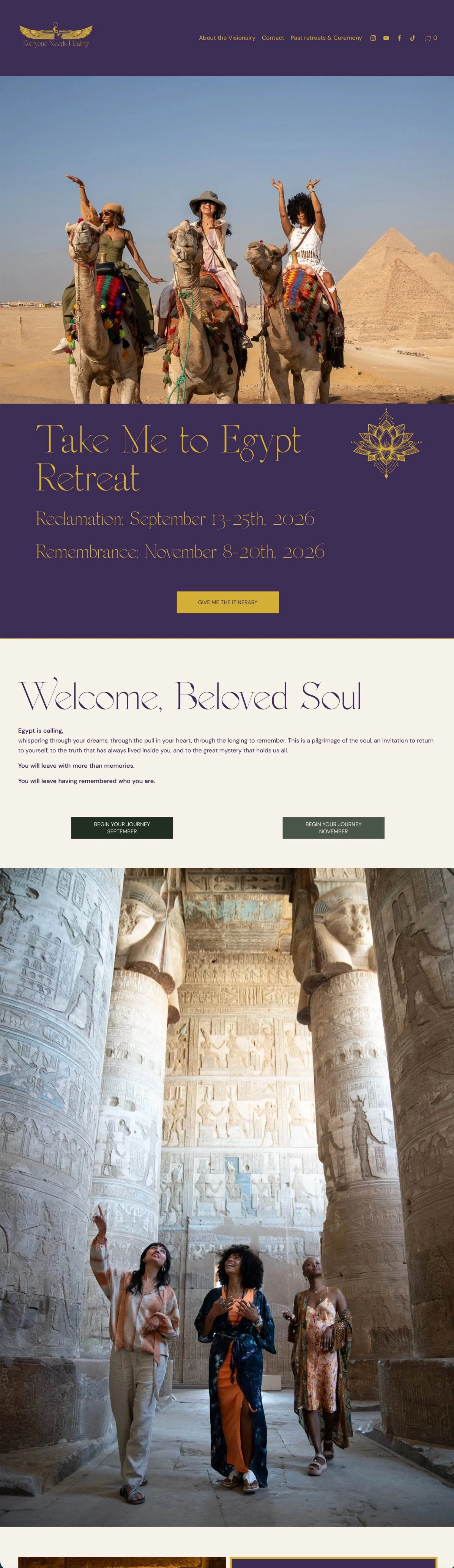
When Paola hired me, I told her: I see Vogue. I see Lexus. I see tall images that take up space the way this experience takes up space. I see large headings that speak volumes before you even read the words. I see a site that takes someone on the journey before they ever book their seat.
The final version of her Egypt retreat page brought Egypt to life. Rich golds and purples and deep teals. Tall columns that seemed to leap off the screen. Each section moving you deeper into the story of what you were about to experience. Not a website. A magazine-inspired experience right at your fingertips.
That is what a website can do for your business when it is built with intention.
Most wellness professionals have the other kind. The one that technically exists. That lists what they offer, maybe has a photo, maybe even looks pretty. But it does not feel like them. And the people who would say yes without hesitation, the ones who would light up the moment they felt your energy, they click away before that moment ever has a chance to arrive.
Here is what changes when your website is built with both soul and strategy behind it.
It shows people who you are before they ever contact you
When a website reflects the person behind it, there is no disconnect. You feel the congruence. You feel when it is right.
When it is not right, you feel that too. Maybe your social media is more alive than your website. Maybe the energy you carry in a room does not match what someone finds when they go looking for you online. The disharmony is real and people sense it before they can name it.
Your people stay when there is congruence. When you shine in your true light, they can feel it. And that recognition, that quiet moment of "that person, they get me," is not an accident. It is what happens when your website is fully, authentically yours.
It works while you teach, hold space, and rest
You know what it means to be fully present with someone. To close the door to everything else and just be there. Your website does not need to do that. It does not need to take a breath or refuel or step away.
It holds the door open while you rest.
It is a relief, honestly. You do not have to be on constantly. Your website is doing the work so you do not have to. And when you rest, you rest fully. You come back to your clients whole. That is not a small thing. That is everything.

It tells Google you exist and why you matter
She asked me again why no one could find her website. It was new. It was shiny. And no one could find it.
She had probably said some version of that a hundred times before I finally had the tools to look into it. When she gave me access to Materia Medica, I could see immediately why. The heading hierarchy was a mess. There were no written SEO titles or descriptions. Pages were missing basic signals. There was an endless loop where there should have been a clear path. Buttons were broken. Images were unoptimized.
One page at a time, I fixed it. Adjusted the headings. Added the SEO. Incorporated keywords naturally. Gave people a clear direction for where to go next.
One day she was not just showing up in searches. She was showing up in AI search results.
Here is the honest thing I want you to hear: SEO is not as complicated as it sounds. It is constantly evolving, yes. But at its core it is about showing Google that you are a real, legitimate business that knows what it is talking about. It is about building an ecosystem where all of that lives and is findable.
And I will also tell you what I told her: a website is one piece. Karen had spent years building real relationships and real connections in her community. The website did not do everything. It did its part. That is what you want it to do.
It filters in the right people and filters out the wrong ones
Your quirks are what distinguish you from everyone else doing the same work.
Your people will find you when your website screams who you are, quirks and all. The specific way you see things. The particular blend of gifts and experiences that nobody else has. The thing about you that makes certain people feel immediately at home and others move on without a second thought.
That is not a problem. That is the whole point.
When someone lands on your site and thinks "that person, they get me," that is not luck. That is what specificity does. A website that tries to speak to everyone ends up speaking to no one. Yours should speak directly to the person who needs exactly what you offer.
It builds trust before the first conversation
By the time someone types their name into your contact form, your website has already done the relational work.
It has shown your philosophy. It has expressed your experience. It has let them sit with you, quietly and in their own time, and decide whether you are the one. Trust is not built in a sales call. It is built in the scrolling. In the reading. In the feeling of recognizing something true.
Your website shows all of that before a single word is exchanged.
It gives your content somewhere to live and grow
Your blog. Your podcast. Your newsletter. These are things you own.
A post on Instagram has a lifespan measured in hours. Content on your website compounds. It builds traction over time. It keeps working long after you wrote it. And it all lives together in one place, a full expression of who you are online that is entirely yours.
Your website is not just a destination. It is a home base. The place where all of the pieces of your ecosystem come together and point in the same direction. Where someone can find not just what you do, but who you are, what you believe, and why that matters.
That kind of presence is built, not posted.
It is the only digital real estate you actually own
Instagram and Facebook are finite. They could be taken away tomorrow. The algorithm changes and suddenly the people who needed to find you cannot. The platform shifts and years of content disappear into a feed no one scrolls back through.
What then?
Your website is your virtual home. A place where everything can live. Posting on social media can be worthwhile, and sharing that same content on your website concurrently gives it more traction and keeps it in your hands. It cannot be taken away. It is yours. Your system. Your land.
Social media is borrowed. Your website is owned. Build accordingly.
Your website should feel like you
Paola's website now takes you somewhere before you ever book. Karen's website now gets found by the people who need what she offers. Two different problems. One truth underneath both of them.
A website that works is not an accident. It is built on purpose, with intention, with the full weight of who you are and what you do embedded in every section and every word.
If you are a yoga teacher, a coach, a healer who knows something is off with your website but cannot quite name it, I see you. Your people are already out there looking for exactly what you offer. The question is whether they can find you when they do.
If you are ready to find out what your website could actually be doing for your business, let's talk.
FAQs
What does a website do for a small service-based business? At its most basic, a website gives your business a home online that you own and control. But a well-built one does much more: it communicates who you are, builds trust before anyone contacts you, helps the right people find you through search, and works as a 24/7 presence even when you are teaching, resting, or offline.
Why is having a website important for a wellness professional? Because your people are looking for you. When someone searches for a yoga teacher, a grief coach, a healer in their area or niche, your website is what determines whether they find you or someone else. It is also the place where the full depth of your work can be expressed in a way that social media simply does not allow.
Can a website replace social media for my business? Not entirely, and that is not the goal. Social media and your website do different things. Social media is how you stay in conversation. Your website is where that conversation lands. The difference is that your website is yours. The content stays, the search value builds, and no algorithm can take it away.
What should a wellness website actually include? At minimum: a clear homepage that communicates what you do and who you serve, an about page that feels like you, a services or offerings page with enough detail that someone can decide whether you are the right fit, a way to contact you or book, and ideally a blog or content section that shows your depth over time. The magic is in how all of those pieces work together, not just that they exist.
How does a website help you get found on Google? Through SEO, which is less technical than it sounds. When your pages have clear titles and descriptions, your content uses words your ideal clients are actually searching for, your headings are structured well, and your images are properly optimized, Google understands what your site is about and who it is for. That is when it starts surfacing you in results.
What is the difference between a website and a social media page? You own your website. You do not own your social media presence. Beyond that, a website can rank in search, hold long-form content, build SEO value over time, and give someone the full picture of your work in a single visit. A social media profile is a snapshot. A website is the whole story.
How long does it take for a website to start bringing in clients? It depends on where you are starting. A site with solid SEO foundations can start showing up in searches within a few weeks to a few months. A redesign that more accurately reflects who you are can start converting visitors into inquiries almost immediately. There is no single timeline, but a website that is built with intention will always outperform one that is not.
